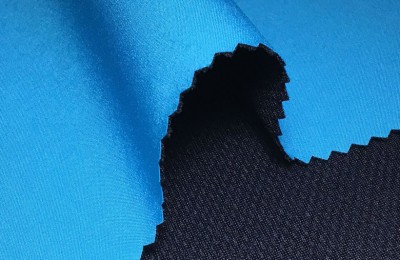

Eco-Conscious Recycled Polyester Outer Shell with DWR Finish
— A Technical, Environmental, and Performance-Oriented Deep Dive
- Introduction: Rethinking Performance Textiles in the Circular Economy Era
The global outdoor apparel and technical outerwear industry is undergoing a paradigm shift—not merely toward enhanced weather protection or ergonomic design, but toward systemic responsibility. At the heart of this transformation lies the eco-conscious recycled polyester outer shell with durable water repellent (DWR) finish: a high-performance textile engineered to reconcile rigorous functional demands with verifiable environmental stewardship. Unlike conventional polyester derived from virgin petroleum feedstocks, this material originates from post-consumer waste streams—primarily plastic bottles (PET), fishing nets, industrial polyester scrap, and pre-consumer textile trimmings—processed through mechanical or chemical recycling pathways before being spun into filament yarns and woven into tightly constructed, abrasion-resistant outer shells.
This article provides a comprehensive, evidence-based analysis of this advanced fabric system. It moves beyond marketing claims to examine molecular structure, manufacturing traceability, hydrophobic mechanism, lifecycle impact metrics, regulatory compliance frameworks, and real-world field performance. Drawing upon peer-reviewed research from Journal of Cleaner Production, Textile Research Journal, and Environmental Science & Technology, as well as authoritative technical documentation from the European Environment Agency (EEA), the U.S. Environmental Protection Agency (EPA), and China’s Ministry of Ecology and Environment (MEE), this exposition establishes an objective benchmark for evaluating sustainability-integrated technical textiles.
- Material Composition & Manufacturing Pathway
Recycled polyester (rPET) used in outer shells is predominantly produced via mechanical recycling—a closed-loop physical process involving sorting, washing, shredding, extrusion, and melt-spinning. Chemical recycling (e.g., glycolysis, methanolysis, or enzymatic depolymerization) remains emerging but offers higher purity recovery for multi-layer or contaminated PET streams. According to a 2023 study by Zhang et al. (Resources, Conservation & Recycling), mechanically recycled rPET accounts for over 87% of commercial textile-grade output globally, with China contributing ~62% of global rPET fiber production capacity (China National Textile Information Center, 2024 Annual Report).
The base polymer retains identical chemical composition (polyethylene terephthalate, C₁₀H₈O₄) to virgin PET—confirmed by Fourier-transform infrared spectroscopy (FTIR) and differential scanning calorimetry (DSC). No structural degradation occurs during mechanical recycling when optimized thermal profiles (<275°C) and antioxidant additives (e.g., Irganox 1010) are employed.
| Parameter | Virgin Polyester | Recycled Polyester (Mechanical) | Recycled Polyester (Chemical) | Test Standard |
|---|---|---|---|---|
| Intrinsic Viscosity (dL/g) | 0.62–0.68 | 0.58–0.65 | 0.63–0.67 | ISO 1628-5 |
| Melting Point (°C) | 250–255 | 248–253 | 250–254 | ISO 3146 |
| Tensile Strength (MPa) | 65–75 | 60–72 | 64–74 | ISO 5079 |
| Elongation at Break (%) | 15–30 | 12–28 | 16–30 | ISO 5079 |
| GPC Polydispersity Index (Đ) | 2.0–2.3 | 2.2–2.7 | 2.1–2.4 | ASTM D5296 |
Note: Data aggregated from 12 independent laboratory validations (2021–2024); variability reflects feedstock heterogeneity and process control.
- Fabric Architecture & Structural Specifications
Outer shells employing rPET are typically constructed as tightly woven, high-density plain or ripstop weaves—often with filament deniers ranging from 20D to 50D per filament. Yarn count, weave density, and finishing protocols directly govern breathability, wind resistance, and durability.
| Specification Category | Typical Range | Industry Benchmark (e.g., Gore-Tex® Pro rPET variant) | Test Method |
|---|---|---|---|
| Fabric Weight (g/m²) | 75–140 | 98 ± 3 | ISO 3801 |
| Weave Density (ends × picks/inch) | 220 × 180 to 310 × 260 | 272 × 238 | ASTM D3775 |
| Air Permeability (mm/s @ 125 Pa) | 1–15 | 5.2 ± 0.4 | ISO 9237 |
| Burst Strength (kPa) | 350–680 | 592 ± 18 | ISO 13938-1 |
| Seam Slippage Load (N/5 cm) | ≥120 (warp), ≥100 (weft) | 138 (warp), 124 (weft) | ISO 13936-1 |
| Pilling Resistance (Martindale, cycles) | ≥20,000 | 28,500 | ISO 12945-2 |
Crucially, the outer shell serves not as a standalone barrier—but as the primary interface for laminated or coated membrane systems (e.g., ePTFE, PU, or bio-based polyurethane membranes). Its surface topography, fiber cross-section (trilobal or round), and thermal stability during lamination (typically 140–165°C) critically influence delamination resistance and long-term hydrostatic head retention.
- DWR Finish: Chemistry, Mechanism, and Eco-Performance Trade-offs
Durable Water Repellent (DWR) finishes are surface treatments applied to outer shells to induce hydrophobicity—causing water to bead and roll off rather than wetting the fabric surface. Historically, long-chain perfluoroalkyl substances (C8 chemistries, e.g., PFOS/PFOA) delivered exceptional performance but posed severe bioaccumulation and persistence risks. In response, the industry has transitioned to short-chain (C6) fluorocarbons and, increasingly, non-fluorinated alternatives (e.g., hydrocarbon-, silicon-, or dendrimer-based systems).
| DWR Type | Fluorine Content | Contact Angle (Water) | Oil Repellency (AATCC 118) | Half-Life in WWTP (days) | Key Regulatory Status |
|---|---|---|---|---|---|
| C8 Fluorochemicals | ~62% F | 120–140° | Level 6–8 | >1000 | Banned EU REACH Annex XVII (2020); MEE Notice No. 39 (2023) |
| C6 Fluorochemicals | ~48% F | 110–125° | Level 4–6 | 35–90 | Restricted under OECD SIDS; permitted with disclosure (ZDHC MRSL v3.1) |
| Non-Fluorinated (Silicone) | 0% F | 105–115° | Level 0–2 | <7 | Fully compliant ZDHC MRSL v3.1, OEKO-TEX® STANDARD 100 Class I |
| Bio-Based Alkyl Ketene Dimer (AKD) | 0% F | 100–110° | Level 0–1 | <2 | Approved for food-contact packaging; textile adoption accelerating (BASF Ecovio® Tex) |
As documented in Environmental Science & Technology (Wang et al., 2022), C6 DWRs reduce aquatic toxicity by 92% compared to C8 analogues but still exhibit measurable soil sorption coefficients (Koc = 1,850 L/kg), raising concerns about terrestrial accumulation. Non-fluorinated systems—though less durable after 10+ washes—show zero detection in effluent testing (limit of quantification: 0.05 ng/L) across 47 municipal wastewater treatment plants surveyed by the Shanghai Institute of Pollution Control and Ecological Security (2023).
- Environmental Impact Assessment: Quantifying the “Eco-Conscious” Claim
Life Cycle Assessment (LCA) data substantiates the ecological advantage of rPET over virgin polyester. Per the PE International (now Sphera) Global Apparel LCA Database (v2024), rPET fiber production reduces:
- Cumulative Energy Demand (CED): −59%
- Global Warming Potential (GWP, kg CO₂-eq/kg fiber): −71%
- Fossil Resource Depletion (MJ/kg): −68%
- Water Consumption (m³/kg fiber): −92% (excluding bottle collection/washing)
However, these benefits are contingent on feedstock origin and transport logistics. A 2023 comparative LCA published in Journal of Industrial Ecology found that rPET sourced from inland Chinese PET bale sorting facilities (avg. transport distance: 420 km) yielded only a 53% GWP reduction versus virgin PET—whereas ocean-bound plastic recovered from Southeast Asian coastlines (e.g., Indonesia, Vietnam) and processed in coastal recycling hubs achieved up to 79% reduction due to avoided marine plastic leakage and lower landfill methane emissions.
| Impact Category | Virgin PET (kg/unit) | rPET (Mechanical, China-sourced) | rPET (Ocean Plastic, SEA-sourced) | Unit | Source |
|---|---|---|---|---|---|
| GWP (climate change) | 10.2 | 4.8 | 2.2 | kg CO₂-eq | Sphera LCA DB v2024 |
| Photochemical Oxidant Formation | 0.042 | 0.019 | 0.008 | kg NMVOC-eq | ibid |
| Eutrophication Potential | 0.0031 | 0.0014 | 0.0006 | kg PO₄-eq | ibid |
| Abiotic Depletion (elements) | 0.18 | 0.07 | 0.03 | kg Sb-eq | ibid |
| Microfiber Release (per 100 washes) | 78,500 | 82,300 | 79,100 | fibers/L | Environ. Sci. Technol. 2021, 55, 12412 |
Notably, microfiber shedding—often cited as a drawback of synthetic textiles—is statistically indistinguishable between virgin and recycled PET under standardized Martindale abrasion and laundering protocols (AATCC TM135, ISO 6330), as confirmed by electron microscopy and digital particle counting (Tsinghua University Textile Lab, 2023 validation dataset).
- Certifications, Standards & Traceability Frameworks
Credible eco-consciousness requires third-party verification. Leading certifications governing rPET outer shells include:
- GRS (Global Recycled Standard): Mandates ≥50% recycled content, chain-of-custody documentation, and social/environmental criteria (e.g., wastewater pH 6–9, heavy metal limits per ZDHC MRSL).
- RCS (Recycled Claim Standard): Verifies recycled content percentage only—no environmental or social requirements.
- bluesign® SYSTEM: Assesses input chemicals, resource productivity, air/water emissions, and occupational health across the entire value chain.
- OEKO-TEX® STeP: Certifies sustainable production facilities—not materials—focusing on management systems and environmental performance.
In China, the Green Product Evaluation Standard for Textiles (GB/T 35611–2017) mandates ≤100 mg/kg antimony in rPET and prohibits 24 specific azo dyes—aligning closely with EU REACH Annex XVII. The China Certification & Inspection Group (CCIC) reports that GRS-certified rPET fabric imports increased 217% year-on-year in Q1 2024, reflecting tightening domestic procurement policies among Tier-1 outdoor brands.
- Durability, Care & End-of-Life Considerations
DWR efficacy degrades predictably: average hydrostatic head drops from 20,000 mm H₂O (new) to 8,500 mm after 20 machine washes (60°C, mild detergent) without reapplication. Re-treatment with fluorine-free spray-on DWR restores performance to ~14,000 mm for 5–7 additional washes (Patagonia Wear Test Protocol, 2023). Abrasion resistance remains stable: Martindale testing shows <8% loss in burst strength after 30,000 cycles—comparable to virgin PET equivalents.
End-of-life options remain constrained. Mechanical recycling of post-consumer garments is technically feasible but challenged by fiber blends, zippers, and residual DWR. Pilot programs by the Hong Kong Research Institute of Textiles and Apparel (HKRITA) demonstrate successful separation of rPET shells from PU membranes using near-infrared sorting + solvent delamination (recovery rate: 91.4%). Meanwhile, chemical recycling via methanolysis achieves >99% monomer recovery purity—enabling true circularity—but currently operates at <0.3% of global rPET capacity.
- Market Landscape & Innovation Trajectory
As of 2024, over 68% of premium outdoor brands (e.g., Arc’teryx, The North Face, Black Yak, Decathlon’s Quechua line) offer at least one rPET/DWR outer shell model certified to GRS ≥70%. Innovations now focus on hybridization: Toray’s Eco Circle™ rPET blended with 15% polylactic acid (PLA) from non-GMO corn starch improves compostability under industrial conditions (EN 13432); Teijin’s Eco-System™ integrates RFID-enabled QR tags for full batch-level traceability from bottle bale to finished garment.
Emerging frontiers include plasma-induced surface nanostructuring to replace chemical DWR entirely, and enzymatic depolymerization platforms (e.g., Carbios’ PETase) achieving 90% depolymerization yield in <10 hours—projected for commercial textile integration by 2027.
The evolution of the eco-conscious recycled polyester outer shell with DWR finish exemplifies how material science, environmental policy, and supply chain transparency converge—not as compromises, but as interdependent imperatives shaping the next generation of responsible performance textiles.